


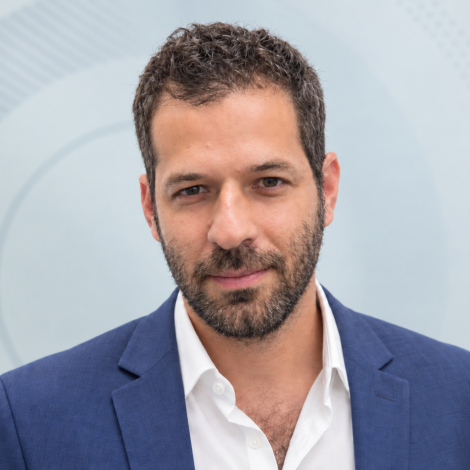
Dr. Roy Azoulay
CV
Dr. Roy Azoulay is a licensed clinical psychologist and Senior Lecturer in the Department of Educational Counseling, Faculty of Education, Bar-Ilan University. Education: B.A. in Psychology and Cognitive Science, The Hebrew University of Jerusalem (2015); M.A. in Clinical Psychology, Bar-Ilan University, with honors (2018); Ph.D. in Psychology, Bar-Ilan University (2024), supervised by Prof. Eva Gilboa-Schechtman and Prof. Tuvia Peri, on the traumatic impact of humiliation events in social anxiety. In 2025–2026 he was a postdoctoral fellow in the Translational Clinical Psychology Lab of Prof. Stefan G. Hofmann at Philipps-Universität Marburg, Germany. He previously taught in the Department of Educational Counseling and the Department of Psychology at Bar-Ilan University and at Yeshiva University (Israel Campus), and coordinated Prof. Gilboa-Schechtman's lab in the Department of Psychology (2017–2023). He is a licensed clinical psychologist, supervises clinical psychology trainees, and practices in a private clinic in Tel-Aviv.
Awards
Minerva Fellowship (Minerva Stiftung, Max Planck Society), 2026
Award for the highest publication record among Ph.D. students in the Social Sciences and Humanities, Bar-Ilan University (2022–2024)
Azrieli Foundation Mention for Exceptional Merit (2021)
Presidential Scholarship, Bar-Ilan University (2019–2022)
Publications
1. Azoulay, R., Pinus, M., Hay, D., & Gilboa-Schechtman, E. (2025). Post-traumatic distress following physical and social stressors: A comparison of symptoms networks. Cognitive Therapy and Research. Advance online publication. https://doi.org/10.1007/s10608-025-10615-z
2. Perets, N., Hay, D. E., Azoulay, R., & Gilboa-Schechtman, E. (2025). Exclusion memories in social anxiety. Cognitive Therapy and Research, 49(4), 835–845. https://doi.org/10.1007/s10608-024-10570-1
3. Azoulay, R., & Gilboa-Schechtman, E. (2024). CyberStatus: Responses to status manipulation and fears of positive and negative evaluations. Journal of Anxiety Disorders, 103, 102845. https://doi.org/10.1016/j.janxdis.2024.102845
4. Azoulay, R., & Gilboa-Schechtman, E. (2024). Specificity of cost and probability biases in social anxiety: Comparing status and belongingness threats. British Journal of Clinical Psychology, 63(3), 273–280. https://doi.org/10.1111/bjc.12472
5. Azoulay, R., Avigadol, L., & Gilboa-Schechtman, E. (2023). Social anxiety and accumulation of status loss events: The role of adulthood experiences. British Journal of Clinical Psychology, 62(2), 518–524. https://doi.org/10.1111/bjc.12417
6. Rahamim, O., Azoulay, R., Keshet, H., Shahar, G., & Gilboa-Schechtman, E. (2023). Apprehensions and aspirations in social anxiety and depression. International Journal of Cognitive Therapy, 16(1), 123–142. https://doi.org/10.1007/s41811-022-00150-0
7. Hay, D. E., Bleicher, S., Azoulay, R., Kivity, Y., & Gilboa-Schechtman, E. (2023). Affective and cognitive impact of social overinclusion: A meta-analytic review of cyberball studies. Cognition and Emotion, 37(3), 412–429. https://doi.org/10.1080/02699931.2022.2163619
8. Zabag, R., Azoulay, R., Rinck, M., Becker, E., Levy-Gigi, E., & Gilboa-Schechtman, E. (2023). You never get a chance to undo a negative first impression: Social anxiety is associated with impaired positive updating of social information. Personality and Individual Differences, 203, 111993. https://doi.org/10.1016/j.paid.2022.111993
9. Azoulay, R., Wilner-Sakal, M., Zabag, R., & Gilboa-Schechtman, E. (2022). Evolutionary perspective on self-concept: The effects of interpersonal motivations and inclusionary status on spontaneous self-descriptions of communion and agency. Evolutionary Psychology, 20(3), Article 14747049221120095. https://doi.org/10.1177/14747049221120095
10. Azoulay, R., & Gilboa-Schechtman, E. (2022). The scarring impact of status loss in social anxiety: An evolutionary perspective. Journal of Anxiety Disorders, 90, 102600. https://doi.org/10.1016/j.janxdis.2022.102600
11. Azoulay, R., & Gilboa-Schechtman, E. (2022). Social construction and evolutionary perspectives on gender differences in post-traumatic distress: The case of status loss events. Frontiers in Psychiatry, 13, Article 858304. https://doi.org/10.3389/fpsyt.2022.858304
12. Gilboa-Schechtman, E., & Azoulay, R. (2022). Treatment of social anxiety disorder: Mechanisms, techniques, and empirically supported interventions. Clinical Psychology and Special Education, 11(2), 1–21. https://doi.org/10.17759/cpse.2022110201
13. Shapira, N., … Azoulay, R., … Goldberg, Y. (2021). Hebrew psychological lexicons. In Proceedings of the Seventh Workshop on Computational Linguistics and Clinical Psychology: Improving Access (pp. 55–69). Association for Computational Linguistics. https://aclanthology.org/2021.clpsych-1.6/
14. Azoulay, R., Berger, U., Keshet, H., Niedenthal, P. M., & Gilboa-Schechtman, E. (2020). Social anxiety and the interpretation of morphed facial expressions following exclusion and inclusion. Journal of Behavior Therapy and Experimental Psychiatry, 66, Article 101511. https://doi.org/10.1016/j.jbtep.2019.101511
15. Gilboa-Schechtman, E., Keshet, H., Peschard, V., & Azoulay, R. (2020). Self and identity in social anxiety disorder. Journal of Personality, 88(1), 106–121. https://doi.org/10.1111/jopy.12455
Research
Dr. Azoulay's research takes a functional, evolutionary perspective that treats symptoms as organized responses to recurring social problems and asks when these responses become maladaptive. The Social Threat & Adaptation Lab studies how interpersonal social threats, namely humiliation, exclusion, and status loss, shape social anxiety, depression, and post-traumatic symptoms, with a focus on adolescence and young adulthood and on educational settings.
Main lines of work:
(1) social trauma: accumulated status-loss events, linguistic analysis of narratives, and symptom networks following social versus physical threats
(2) social anxiety as low-status regulation, in collaboration with Prof. Stefan G. Hofmann (Philipps-Universität Marburg), including the CyberStatus paradigm for experimentally manipulating social rank
(3) grandiose narcissism as rank sensitivity
(4) methods: ecological momentary assessment (EMA), symptom-network models, and analyses of large pooled questionnaire datasets
(5) process-based intervention (PBT) in schools and on campus, aimed at screening tools and brief interventions that school counselors can use
(6) an evolutionary approach to psychopathology.
Courses
- Cognitive Approaches in Educational Counseling (M.A., Department of Educational Counseling)
- Pain and Psychological Resilience (Faculty of Education)
- Seminar on Social Anxiety (B.A., Faculty of Education)
Fields of Expertise
- Social anxiety; social trauma (humiliation, exclusion, and status loss) in adolescence and young adulthood
- Grandiose narcissism and rank sensitivity
- Evolutionary approaches to psychopathology
- Ecological momentary assessment (EMA) and symptom networks
- Process-based intervention (PBT) in educational settings
- Clinical psychology
Last Updated Date : 12/10/2026