


Best Paper Award, 2023 AERA Organizational Theory SIG
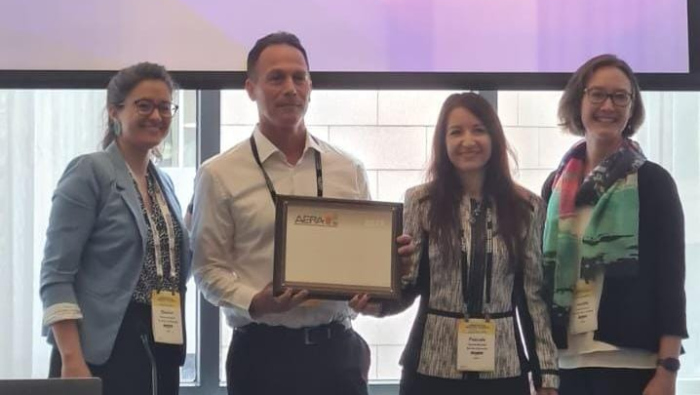
Prof. Pascale Benoliel and Prof. Chen Schechter are receiving the
Best Paper Award, 2023 AERA Organizational Theory SIG
Business meeting, Chicago, USA.
For their article: Benoliel, P. & Schechter, C. (2023). Smart collaborative ecosystem: Leading complex school systems. Journal of Educational Administration, 61(3), 239-255.
https://www.emerald.com/insight/content/doi/10.1108/jea-09-2022-0146/full/html
Abstract
The need to innovate and apply alternative forms of school organization is evident as the COVID-19 pandemic has generated a need to establish new conceptualizations of schools and education management. The paradigm shift in learning inexorably necessitates a corresponding paradigm shift in educational organization, administration, and management to build organizational resilience and capital. This proposed study framework seeks to address this issue by proposing a transformation of educational organization and management, shifting away from the unilateral, hierarchical school models and towards a unique, smart collaborative school ecosystem in which residents, industries, schools, universities and research centers can create new digital knowledge and inventive products, services and solutions by enlarging their capitals. Drawing upon Bourdieu’s theory of social capital, our theoretical contribution is to present the influence of three forms of capital (social, economic, and cultural) in cultivating educational capacity and resilience in the school ecosystem, with a particular focus on the role of digital capital in reinforcing the school ecosystem's capitals. The authors also argue that ecosystem leaders and principals, as boundary spanners, play an important role in promoting capital exchange and enlargement as they balance the permeability of organizational boundaries at times of crisis by maneuvering across fields. Achieving educational improvement and building organizational capacity and resilience through the enlargement of system (and subsystem) capitals requires that key actors develop synchronized interpretations of educational aims and functions in various contexts. The authors delineate the importance of developing a synchronization strategy in the proposed conceptualization of smart and resilient school ecosystems. By integrating research from both non-educational and educational literature, the proposed framework provides a new perspective for educational administration, organization and management, shifting away from the unilateral, hierarchical school models toward a unique, smart collaborative school ecosystem in which members can create new knowledge by enlarging their capitals. Practical lessons for leaders and policymakers from our conceptual framework are proposed.
Last Updated Date : 12/06/2025